Four pillars,
one quiet morning.
Sajuga turns the chart your grandmother trusted into a one-page letter you'll actually read with your coffee. Saju, hexagram, and timing — every day, a little wiser.
Four moments
that made you.
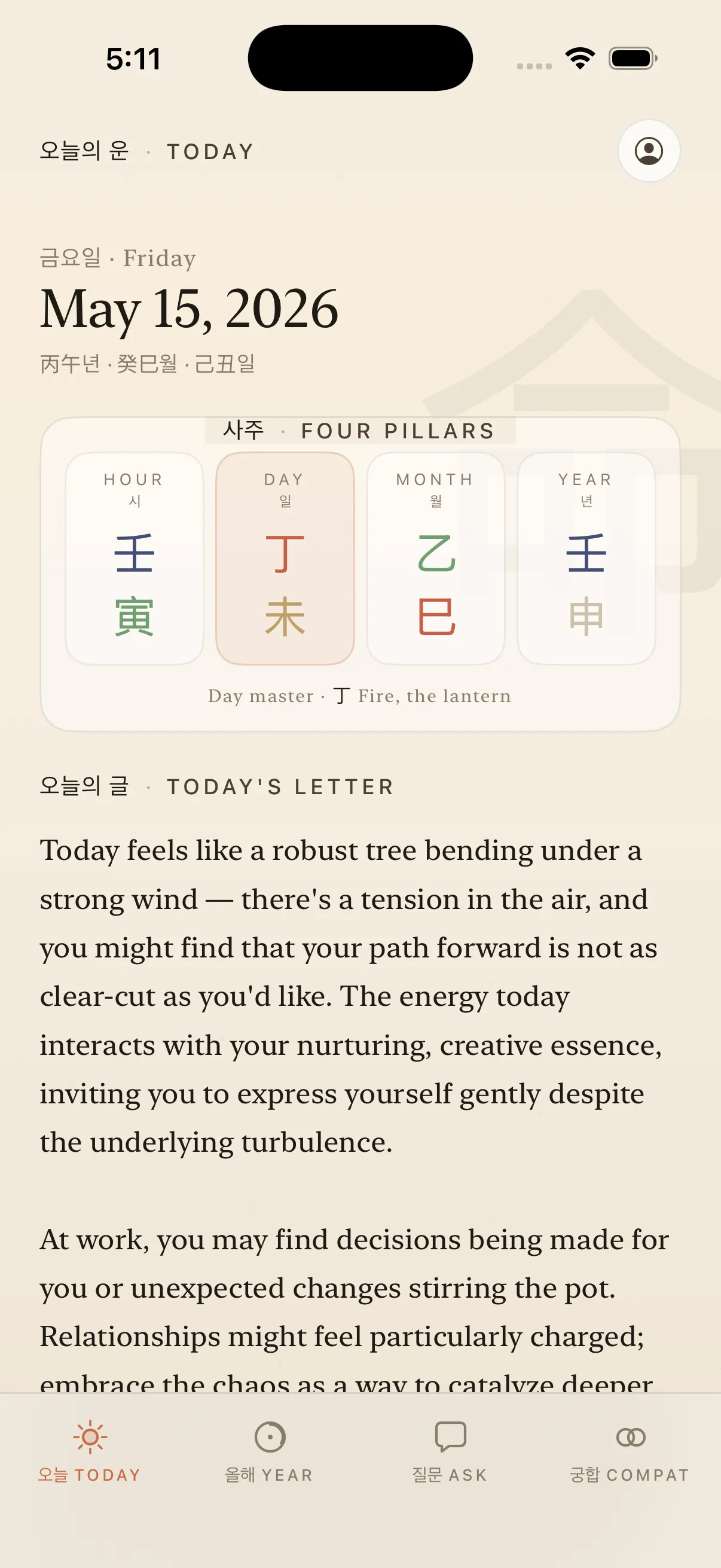
Saju (사주, 四柱) means four pillars. The year, month, day, and hour you were born — each one a small cosmological signature, in heavenly stems and earthly branches.
Together, they describe your day master — the elemental nature that quietly shapes how you meet the world. Mountain, river, fire, blade, tree. Then, every day, the calendar moves through its own pillars and meets yours. Some meetings are nourishing. Some are tense. Most are ordinary.
Sajuga reads that meeting for you, in language you can use before lunch.
Three guides to read your own chart.
Long-form pieces, written for an English-speaking reader who wants to actually understand Saju — not just hear it described.
What Is Saju?
The complete English guide to Korean four pillars — what the eight characters mean, where the system came from, and what it can and can't tell you.
Read the guideHow to Read Your Saju
A step-by-step walkthrough: find your day master, weigh the five elements, compute the ten gods, and put it all together on a real chart.
Read the guideSaju Compatibility
How Korean astrology reads relationships — day master interaction, branch harmonies and clashes, and what kind of weather two charts make together.
Read the guideToday, the year, the question, and the partner.
A daily letter, not a horoscope.
Each morning, Sajuga reads how today's pillars meet yours and writes it as a short bilingual letter. Stars on five life areas, an I-Ching hexagram for the moment, a lucky number, color, and direction.
See the weather of your year.
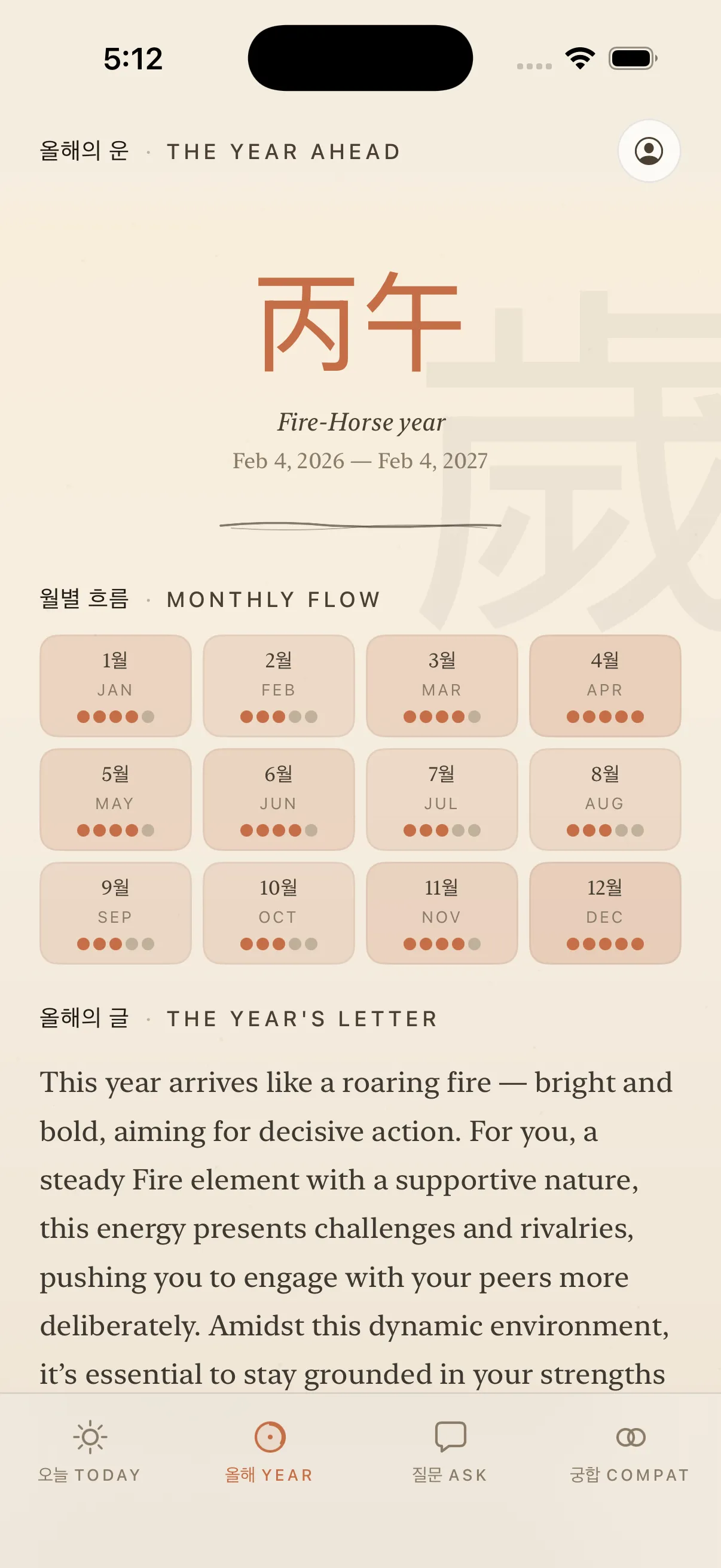
A timing track shows your high and low months at a glance. Each season gets a short note — when to be visible, when to prune, when to rest. Use it to plan, not to worry.
Ask the chart a real question.
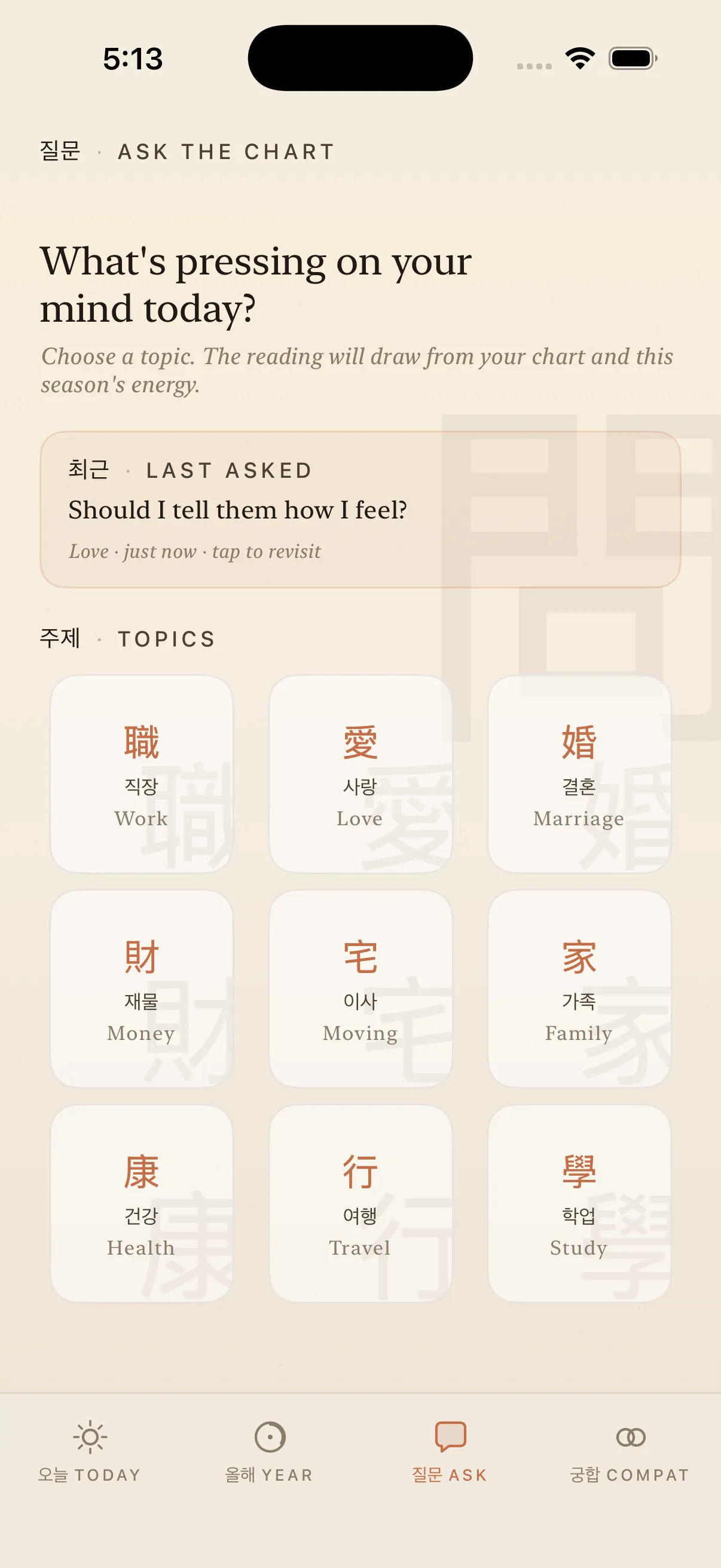
Nine topics — work, love, marriage, money, health, family, study, move, decision — each with curated starter questions. The reading lands as prose, not a quick answer.
How two charts meet.
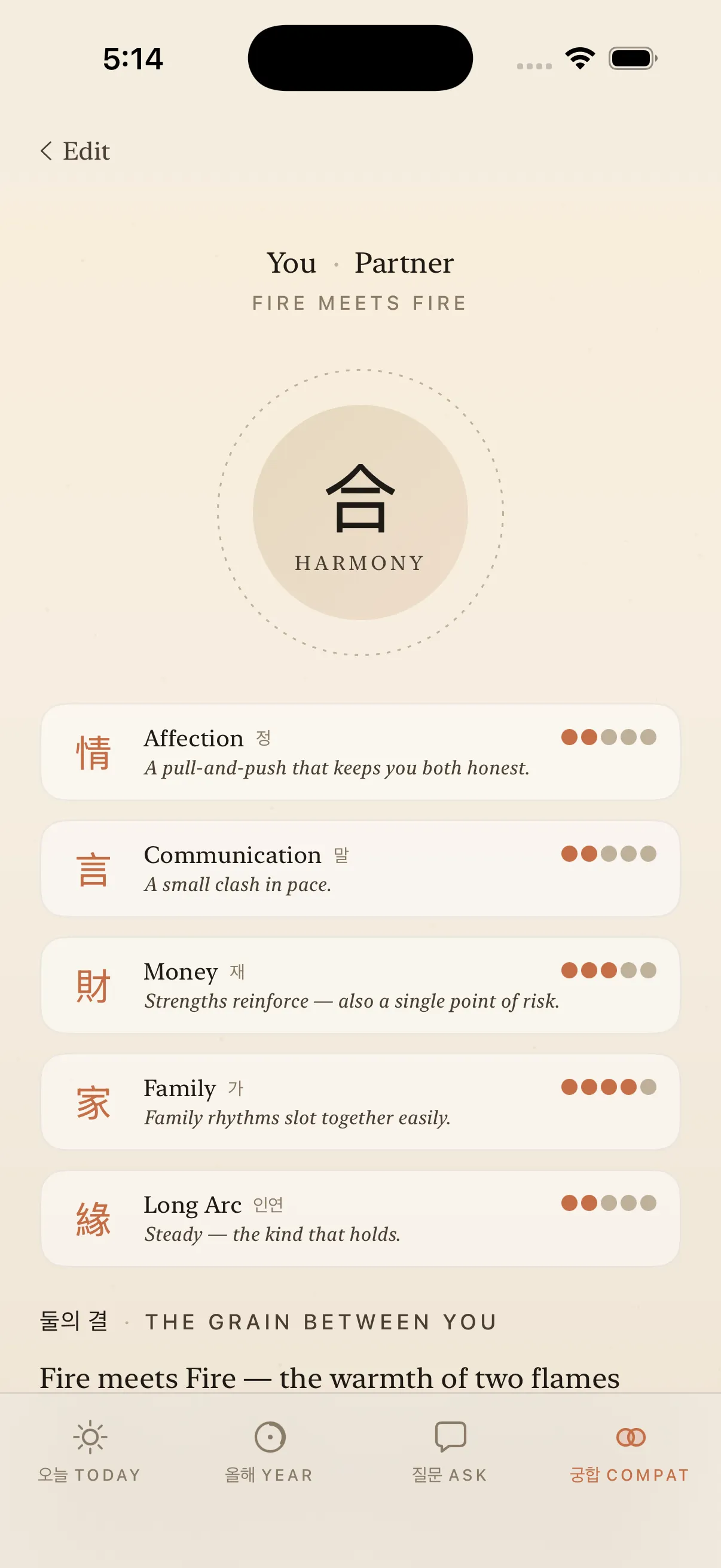
Add a partner's birth info and Sajuga reads the shape of you together — element flow, the rough edges, where you nourish and where you grind. A single rating, four sub-stars, and a frank paragraph.
From birth chart to morning letter.
Three steps. The math is the engine your grandmother's reader would recognize — written down in code, run on your phone.
Date, time, place, sect. Two minutes. Stored on your device.
Sajuga computes your four pillars and day master locally — no server round-trip for the math.
Open Sajuga in the morning. Today's reading is already written, in your language.
Things people ask before they download.
Do I need to know anything about Saju to use this? +
No. Sajuga writes every reading in plain English (and Korean). The hanja and Korean characters are there because the tradition asks for them — but you'll never need to interpret them yourself.
How is this different from a horoscope? +
Western horoscopes use 12 sun signs. Saju uses your four pillars — year, month, day, and hour — which gives roughly 518,400 unique starting positions. Your reading isn't "Earth signs today," it's how today's pillars meet yours specifically.
Where does the math come from? +
Sajuga uses the same plum-blossom and Saju calculations that practitioners have used for centuries — written down so your phone can run them. Your chart is computed locally, every time.
What about my privacy? +
Your birth info stays on your phone. To write each day's reading, Sajuga sends only the computed chart — never your name or birth details — and nothing about you is kept once the reading is written.
I don't know my birth time. Can I still use it? +
Yes. You can pick "unknown" for the hour and Sajuga will write three-pillar readings — the day master is still the strongest signal, and most of what you'd want is still there. You can add your hour later.
Korean tradition or Chinese tradition? +
Sajuga uses the Korean Saju lineage — 정격 / 종격 sect distinctions and the modern Korean reading conventions. The four pillars are common across East Asian traditions; the framing is Korean.
Tomorrow's reading
is already written.
You just have to open it.